Phenyl-modified silicones are frequently selected when a formulator needs more than basic slip. They can influence gloss, optical clarity, pigment wetting, spreadability, water resistance, hair shine, and the sensory transition that consumers feel during application. Yet three materials with similar-looking names may behave very differently in a finished formula. Choosing by INCI name alone can therefore lead to haze, excessive drag, weak payoff, instability, or a product that looks excellent in the beaker but fails after scale-up.
This guide compares three commercially important options: phenyl trimethicone, trimethyl pentaphenyl trisiloxane, and trimethylsiloxyphenyl dimethicone. It explains what their structures imply, how to interpret practical specifications, where each option can fit, and how to build a selection process that is defensible to technical, quality, procurement, and brand teams. The numbers cited for LANCHEMIE grades are representative product specifications and should always be confirmed against the current technical data sheet, certificate of analysis, and sample supplied for a specific order.
The objective is not to declare a universal winner. The correct material is the one that meets the target sensory profile, optical requirement, process window, regulatory market, packaging system, and cost-in-use target of your formula. A structured evaluation can reduce reformulation cycles and make supplier conversations substantially more productive.
What Is Phenyl Trimethicone?
Phenyl trimethicone is a phenyl-modified silicone fluid used to provide gloss, conditioning, emolliency, spreadability, and a more substantive sensory profile than many low-viscosity dimethicone fluids.
In conventional dimethicone, the silicone backbone is mainly surrounded by methyl groups. In phenyl trimethicone, a portion of those organic groups is phenyl-based. That structural change affects properties that matter in formulation, especially refractive index, compatibility with selected oils and organic ingredients, gloss development, and the balance between slip and cushion. The material is often considered for hair serums, shine products, skin care, color cosmetics, and formulas where optical appearance is important.
A representative LANCHEMIE phenyl trimethicone grade, LC-PTM, is specified with a viscosity of 15–30 mm²/s at 25°C, a refractive index of 1.455–1.463, and a flash point of at least 100°C. These values describe a relatively mobile fluid with an optical index above many common low-viscosity methyl silicones. In practical terms, it can deliver fast spreading with a polished, non-waxy finish, while the measured flash point remains an important input for storage, processing, transport, and plant safety review.
Phenyl trimethicone should not be treated as a one-for-one substitute for every dimethicone. Even when two materials appear similar in viscosity, their compatibility, gloss, evaporation profile, wetting behavior, and after-feel may differ. A successful replacement study therefore compares the complete formula rather than only the raw-material specification.
Why Phenyl Modification Changes Silicone Performance
Phenyl modification changes the electronic and spatial environment around the silicone backbone, which can raise refractive index and alter compatibility, substantivity, gloss, and sensory behavior.
Refractive index is especially relevant to transparent oils, hair shine products, lip products, foundations, primers, and anhydrous systems. When the refractive indices of several ingredients are closer, a blend may appear clearer and more uniform. When they are far apart, haze can increase. This does not mean that a high refractive index automatically creates a better product. Optical performance depends on the entire dispersed and continuous phase, particle size, pigment treatment, wax crystallization, and the final film thickness.
Phenyl groups may also improve compatibility with selected organic oils, aromatic components, UV filters, and resinous materials. Compatibility is still formulation-specific. A material that remains clear in one ester blend may haze in another because of polarity, concentration, cooling rate, or the presence of waxes. Formulators should evaluate compatibility at the intended use level and at elevated and reduced temperatures rather than relying on a room-temperature vial alone.
Sensory behavior is another reason to evaluate phenyl silicones separately. The consumer may perceive a change in cushion, glide, richness, payoff, tack reduction, and residual film. These changes can be beneficial in premium hair care or color cosmetics, but an overly rich grade may conflict with a “weightless” claim. The selection process should begin with a defined sensory target such as “fast initial slip, medium cushion, high dry shine, and no greasy residue after five minutes,” not with a generic request for “a better silicone.”
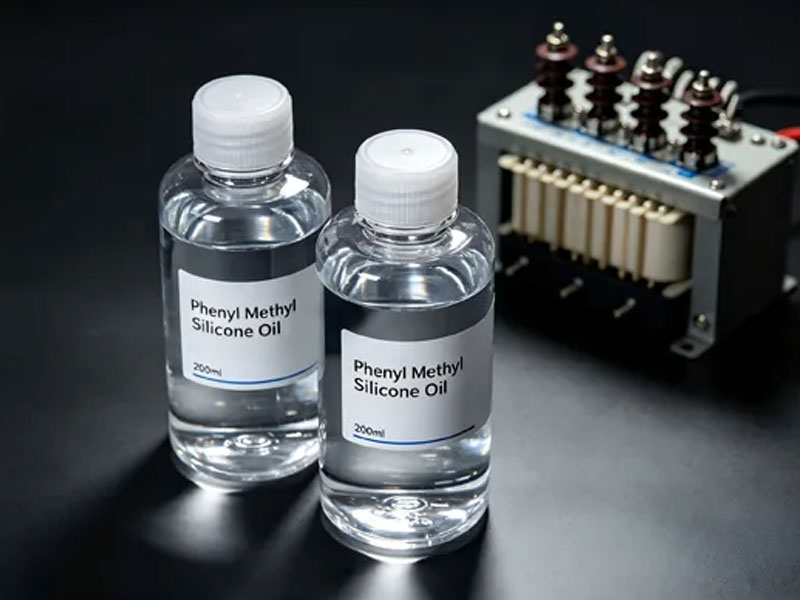
What Is Trimethyl Pentaphenyl Trisiloxane?
Trimethyl pentaphenyl trisiloxane is a compact, highly phenylated silicone fluid selected when a formulator needs very high refractive index, strong gloss potential, and compatibility with suitable oil-phase ingredients.
Compared with a typical phenyl trimethicone, this material has a greater phenyl contribution in a smaller siloxane structure. The result is a markedly higher refractive index and a denser, more substantive sensory profile. A representative LANCHEMIE trimethyl pentaphenyl trisiloxane grade, LC-5175, is specified at 175 ± 2 mPa·s viscosity at 25°C, a refractive index of 1.5700–1.5800, and a flash point of 243°C.
The difference between a refractive index near 1.46 and one near 1.57 is meaningful in optical design. It can support high-shine effects and help formulators manage clarity in blends containing high-index components. However, the higher viscosity and different structure can also change pourability, incorporation time, payoff, and final film. A formula developed around a 20 mm²/s fluid should not be expected to behave identically when replaced with a material near 175 mPa·s.
This grade may be evaluated in lip products, hair gloss treatments, high-shine color cosmetics, specialty skin care oils, and systems requiring a rich optical finish. It is particularly valuable as a targeted functional component rather than a default bulk emollient. Its cost-in-use should therefore be judged by the performance delivered at the optimized dosage, not simply by price per kilogram.
What Is Trimethylsiloxyphenyl Dimethicone?
Trimethylsiloxyphenyl dimethicone is a phenyl-containing silicone designed to combine silicone slip and conditioning with enhanced gloss, film character, and compatibility in selected cosmetic oil phases.
The name indicates a dimethicone-type backbone with phenyl-containing functionality and trimethylsiloxy termination. In practice, commercial grades can differ in viscosity, phenyl content, refractive index, molecular-weight distribution, and sensory profile. The current supplier specification is therefore more important than the generic INCI name when making a formula decision.
LANCHEMIE offers trimethylsiloxyphenyl dimethicone LC-5177 as a phenyl silicone option. Before final selection, request the current TDS and SDS, confirm the test method behind each reported value, and ask for a representative production sample. Where optical clarity or pigment wetting is critical, obtain refractive-index data and evaluate the grade directly in the target oil phase.
This material can occupy a useful middle ground in a product-development program. It may provide more structure or film character than a very light phenyl trimethicone while remaining easier to process than a highly phenylated, higher-viscosity fluid. That positioning must be proven in your formula because the surrounding oils, elastomers, resins, waxes, powders, and actives can shift the result.
Phenyl Trimethicone Comparison: Key Technical Differences
A useful phenyl trimethicone comparison evaluates refractive index, viscosity, flash point, sensory profile, optical effect, compatibility, and intended use rather than relying on ingredient names alone.
| Selection Factor | Phenyl Trimethicone LC-PTM | Trimethyl Pentaphenyl Trisiloxane LC-5175 | Trimethylsiloxyphenyl Dimethicone LC-5177 |
|---|
| Representative viscosity | 15–30 mm²/s at 25°C | 175 ± 2 mPa·s at 25°C | Confirm current TDS and test method |
| Representative refractive index | 1.455–1.463 | 1.5700–1.5800 | Confirm current TDS for optical matching |
| Representative flash point | At least 100°C | 243°C | Confirm current SDS/TDS |
| Expected flow | Low-viscosity, easy-spreading fluid | More viscous and substantive | Grade-dependent intermediate profile |
| Primary development reason | Gloss, slip, conditioning, versatile oil-phase use | Very high optical index and premium shine | Balanced gloss, film character, and silicone sensory |
| Typical screening areas | Hair serum, skin oil, color cosmetics, shine products | Lip products, high-gloss hair care, specialty color cosmetics | Color cosmetics, hair care, skin care, hybrid oil systems |
| Main formulation risk | Unexpected haze or insufficient structure | Excessive richness, drag, or processing difficulty | Assuming all commercial grades are equivalent |
The units in supplier documents should be reviewed carefully. Kinematic viscosity in mm²/s and dynamic viscosity in mPa·s are not automatically interchangeable unless density and measurement conditions are accounted for. A procurement specification should preserve the supplier’s test method, instrument, temperature, spindle or capillary conditions, and acceptance range. Comparing only the numerical value without the method can create false equivalence.
The table is a screening tool, not a substitute for a finished-formula trial. A material with the highest refractive index may not yield the clearest final product if wax crystallization, pigment agglomeration, or phase separation dominates the optical result. Similarly, the lowest-viscosity material may not deliver the best spread if the overall rheology is controlled by elastomers or powders.
How to Choose a Phenyl Silicone for Hair Care
Hair-care selection should match the phenyl silicone’s deposition, gloss, weight, spreading, thermal exposure, and compatibility to the hair type and product format.
Begin by defining the format. A clear hair serum, rinse-off conditioner, leave-in cream, heat-protection spray, shine mist, and styling oil impose different requirements. An anhydrous serum may prioritize clarity and dry shine, while an emulsion must also maintain phase stability and deposition. A fine mist requires low enough viscosity and suitable solvency for the pump, whereas a dropper oil can tolerate a richer flow.
For light serums, phenyl trimethicone may be a practical starting point because its low viscosity supports fast spreading and easier blending. Test it at several levels around the expected dosage, then evaluate combing, gloss, flyaway control, residue, and wash-off. For a premium gloss concentrate, trimethyl pentaphenyl trisiloxane can be screened when stronger optical impact is desired. Its higher viscosity means the formulator may need to balance it with lighter carriers.
Use standardized hair tresses rather than hand feel alone. Apply a controlled mass per gram of hair, allow a fixed drying period, and assess gloss under consistent lighting. Include at least one untreated control and one benchmark product. Record wet combing, dry combing, fiber separation, tack, and visible residue. If heat styling is part of the claim, design a specific protocol with the intended temperature and number of passes; do not infer thermal protection from flash point.Consumer segmentation also matters. Fine, straight hair may show overload at a dosage that performs well on coarse, curly, bleached, or high-porosity hair. A global formula may require a compromise, while a professional range can support differentiated products. Supplier samples should be tested on the actual target hair types before a commercial decision.
How to Choose a Phenyl Silicone for Skin Care and Sun Care
Skin-care and sun-care selection should balance spreadability, oil-phase compatibility, after-feel, film continuity, optical appearance, and the regulatory status of every ingredient in the target market.
In skin care, phenyl silicones can help refine glide and reduce the heavy perception of some oils. They can be useful in facial oils, primers, anhydrous sticks, emulsions, and high-performance sensory systems. The desired finish must be explicit: dewy, satin, powdery, glass-like, or natural. A high-gloss ingredient can undermine a soft-focus concept unless it is balanced with elastomer powders or absorptive fillers.
Sun-care formulas add complexity because UV filters can be difficult to solubilize and can crystallize during storage. A phenyl silicone may improve compatibility with selected filters, but this must be proven by microscopy, centrifugation, thermal cycling, and analytical testing. It is not appropriate to claim that an ingredient increases SPF without validated in vitro and in vivo testing of the finished sunscreen.
For emulsions, add the phenyl silicone to the appropriate oil phase and verify that the emulsifier system can accommodate it. Examine droplet size, viscosity, pH drift, and phase separation over time. In water-in-silicone or silicone-rich systems, compatibility with the silicone emulsifier and elastomer network is especially important. In oil-in-water systems, excessive hydrophobic load may require a reformulated emulsifier package rather than a simple ingredient swap.
Packaging is part of the test. A formula can remain stable in glass but interact with a plastic bottle, gasket, wiper, or pump. Evaluate leakage, paneling, swelling, dose consistency, and decorative coating compatibility. The goal is a complete product system, not a raw-material success in isolation.
Phenyl Trimethicone in Color Cosmetics
In color cosmetics, phenyl trimethicone and related phenyl silicones are used to manage pigment wetting, gloss, spread, payoff, film feel, and optical clarity.Color cosmetics require simultaneous control of liquid phase, powders, pigments, waxes, and film-forming ingredients. A phenyl silicone can improve the way pigments are wetted and distributed, but the result depends on pigment surface treatment and mixing energy. Untreated mineral pigments, silicone-treated pigments, fluorinated treatments, and amino-acid treatments may respond differently.
For foundations and concealers, compare color strength and undertone after full dispersion. Poor wetting can produce streaking, unstable shade, or lower apparent coverage. A high-index fluid may also change the way light interacts with the film, which can affect perceived shade and shine. Shade matching should therefore be repeated after changing the silicone phase.
In lip products, optical index and gloss are important, but so are taste, odor, migration, payoff, adhesion, and wax compatibility. A highly phenylated fluid can create a premium shine, yet too much may soften the stick or change the crystallization network. Conduct pay-off testing at controlled temperature and measure stick hardness, break strength, sweating, and syneresis.
In eye products, verify permitted use, impurity profile, and local regulatory requirements. Evaluate migration and compatibility with packaging applicators. Claims such as long wear or transfer resistance must be substantiated on the finished product; ingredient selection only contributes to the system.
Optical Design and Refractive-Index Matching
Refractive-index matching is the practice of selecting liquid and solid phases with compatible optical properties to improve clarity, transparency, gloss, or controlled light scattering.
A simple first screen is to measure the clarity of binary and ternary blends at the intended ratio. Prepare samples in clear, identical vials and observe them immediately, after 24 hours, and after temperature exposure. Use a haze meter or spectrophotometer when optical appearance is a critical quality attribute. Human observation is useful but can be influenced by lighting and background.
For transparent oil gels, the refractive index of the gellant or elastomer phase must also be considered. A fluid with a very high index may look brilliant alone but create haze when combined with a lower-index network. Conversely, a carefully matched combination can produce excellent clarity. Supplier technical support can help identify likely combinations, but the final formula and manufacturing process determine the outcome.
In pigmented systems, perfect clarity is not the target. Instead, the formulator may want improved color saturation, gloss, or reduced whitening. Measure color using L*, a*, and b* values where appropriate, and compare drawdowns at a controlled film thickness. Keep pigment concentration, mixing time, and substrate constant. This converts an aesthetic impression into data that can be shared across R&D, quality, and marketing teams.
Optical design must also account for aging. Waxes can recrystallize, powders can settle, and resins can form microdomains that change haze. A clear sample on day one is only the beginning of the stability program.
A Practical Bench-Scale Selection Workflow
A bench-scale selection workflow is a controlled sequence of screening, compatibility, prototype, stability, and sensory tests used to identify the most suitable phenyl silicone with minimal formulation risk.
Write a target product profile. Define format, appearance, viscosity, application, finish, packaging, market, claims, and cost target before requesting samples.
Select two or three candidate grades. Include a low-viscosity phenyl trimethicone, a high-index option, and a balanced phenyl dimethicone where relevant.
Run neat and blend observations. Record color, odor, clarity, viscosity, and miscibility with each major oil-phase ingredient.
Build concentration ladders. Test at least three levels around the expected use concentration while keeping all other variables constant.
Measure critical attributes. Depending on format, include viscosity, gloss, haze, color, payoff, combing, tack, film weight, centrifugation, and freeze-thaw behavior.
Perform accelerated stability. Use conditions appropriate to the company protocol, such as ambient, elevated temperature, low temperature, and cycling. Include packaging compatibility.
Confirm scale-up behavior. Reproduce the selected batch using pilot equipment and realistic addition order, shear, heating, cooling, and deaeration.
Lock the raw-material specification. Agree on INCI, product code, test methods, ranges, documentation, packaging, and change-control expectations.
The most important discipline is changing one major variable at a time during the early screen. If the silicone, emulsifier, oil blend, powder level, and mixing process are all changed together, the team cannot identify the cause of an improvement or failure. Once a strong candidate emerges, factorial design can be used to study interactions more efficiently.
Compatibility, Stability, and Processing Risks
Compatibility and processing risks arise when a phenyl silicone interacts unfavorably with oils, waxes, pigments, elastomers, resins, emulsifiers, packaging, heat, or shear.
Haze is a common early warning. It may result from incomplete solubility, a refractive-index mismatch, moisture contamination, wax crystallization, or temperature-dependent separation. Heating can temporarily clear an incompatible blend, so samples should be assessed after controlled cooling and aging. A clear hot batch is not evidence of room-temperature stability.
Viscosity drift can occur when the new fluid swells an elastomer differently, changes dispersed-phase volume, or disrupts a wax network. Record viscosity with a defined method and at several time points. For highly thixotropic systems, specify pre-shear and rest time. A single reading taken immediately after mixing can be misleading.
Air entrapment is another issue, particularly with more viscous phenyl fluids. Adjust addition position, mixing speed, and deaeration. Vacuum processing may be useful, but it should be validated against volatile components and equipment limits. High shear is not always beneficial; it can raise temperature, introduce air, or damage a structured network.
Color and odor must be included in quality assessment. Even subtle raw-material variation can become visible in clear or pale formulas. Establish incoming inspection criteria that are realistic for the product and aligned with the supplier’s manufacturing capability.
Quality Specifications and Supplier Documentation
A robust purchase specification defines identity, critical physical properties, impurity controls, test methods, documentation, packaging, traceability, and change-management requirements.At minimum, request the current TDS, SDS, certificate of analysis format, INCI declaration, country of origin, shelf life, storage conditions, and packaging information. Depending on the application and market, additional documents may include allergen statements, animal-testing statements, regulatory status, heavy-metal data, residual monomer information, microbiological rationale, and declarations for restricted substances.
Do not copy every TDS line into a purchase specification without assessing business relevance. Identify which attributes directly affect product performance. For a clear hair serum, refractive index, viscosity, appearance, and color may be critical. For a color cosmetic, compatibility, odor, and lot consistency may be equally important. Flash point is essential for safety and logistics but is not a direct predictor of heat-protection performance in hair.
Ask how the supplier handles change notification. A change in raw-material source, manufacturing route, test method, or production site can affect a sensitive formula even when the published specification remains unchanged. A documented change-control expectation reduces surprises after commercialization.
Sample traceability matters. The sample used for approval should be linked to a batch number and representative production process. After selection, compare the first commercial lot with the approved sample and retain reference samples under controlled conditions.
Cost-in-Use: Why Price per Kilogram Is Not Enough
Cost-in-use measures the total formula and manufacturing impact of an ingredient at its effective dosage rather than evaluating only its purchase price per kilogram.Consider a hypothetical 1,000 kg batch. Ingredient A costs less per kilogram but requires 5% to reach the desired gloss, while Ingredient B costs 50% more per kilogram but reaches the target at 2%. Ingredient B may have the lower batch cost. The calculation must also include any changes to carrier oils, waxes, pigments, processing time, yield loss, filtration, and packaging.
Performance failures are expensive. A lower-priced fluid that causes haze after six weeks can trigger reformulation, stability repeats, delayed launch, scrapped packaging, and customer complaints. Procurement should therefore compare qualified alternatives after technical testing, not replace a specialty silicone based solely on a quotation.
Supply reliability has economic value as well. Review lead time, minimum order quantity, packaging size, safety-stock needs, and the supplier’s ability to maintain consistent lots. A technically superior grade may still be unsuitable if its lead time conflicts with the production plan. Conversely, a stable supplier relationship can justify a modest premium when it reduces emergency freight and quality risk.
Document the selection rationale in a cross-functional scorecard. Weight technical performance, documentation, compliance support, supply reliability, service, and cost according to project priorities. This makes the decision auditable and prevents the lowest visible price from dominating a complex product choice.
Frequently Asked Questions About Phenyl Trimethicone
These frequently asked questions address common formulation, substitution, testing, and purchasing decisions involving phenyl trimethicone and related phenyl silicones.
1. Is phenyl trimethicone the same as dimethicone?
No. Both are silicone fluids, but phenyl trimethicone contains phenyl modification that can change refractive index, compatibility, gloss, and sensory performance. They should not be substituted without formula testing.
2. Which option has the highest refractive index?
Among the representative LANCHEMIE grades compared here, LC-5175 trimethyl pentaphenyl trisiloxane is specified at 1.5700–1.5800, while LC-PTM phenyl trimethicone is specified at 1.455–1.463. Confirm current specifications for every lot and grade.
3. Can phenyl trimethicone improve sunscreen SPF?
It may influence spreading, film formation, and filter compatibility, but no ingredient-level assumption can establish an SPF increase. Any SPF or UVA claim must be validated on the finished formula using appropriate testing.
4. How should I screen phenyl silicones for a clear hair serum?
Compare at least three concentration levels, evaluate clarity and haze at multiple temperatures, measure gloss on standardized hair tresses, and assess residue, combing, packaging delivery, and accelerated stability.
5. Can trimethyl pentaphenyl trisiloxane replace phenyl trimethicone one to one?
Usually not without adjustment. The representative grades differ substantially in viscosity and refractive index, so replacing one with the other can alter flow, payoff, compatibility, and final sensory character.
6. What should I request before purchasing a commercial lot?
Request the current TDS, SDS, COA format, INCI statement, shelf life, storage conditions, packaging, lead time, sample traceability, regulatory documentation for the target market, and a formal quotation.
Conclusion
The best phenyl silicone is the grade that meets a defined optical, sensory, stability, processing, regulatory, supply, and cost-in-use target in the finished product.Phenyl trimethicone offers a versatile combination of mobile flow, gloss, conditioning, and an elevated refractive index. Trimethyl pentaphenyl trisiloxane provides a much higher refractive index and a more substantive profile for demanding optical and shine applications. Trimethylsiloxyphenyl dimethicone can provide a balanced route when a formula needs silicone slip together with additional film character. None should be selected from the name alone.
A disciplined process begins with a target product profile, compares traceable samples, uses quantitative optical and rheological measurements, includes packaging and accelerated stability, and locks the relevant supplier specification before launch. This approach creates useful evidence for R&D, quality, procurement, and marketing while reducing the risk of expensive late-stage changes.
LANCHEMIE can support the screening process with relevant phenyl silicone samples and current technical documentation. Share your formula format, target finish, key oil-phase ingredients, market, and expected annual demand to request a focused recommendation, sample plan, and quotation.
External References
The following independent resources provide background on phenyl trimethicone, cosmetic ingredient functions, and silicone chemistry.

 English
  日本語
日本語  한국어
한국어  français
  Español
  русский
  português
  العربية
  Polska
  Svenska